Turn your living room into a winter oasis

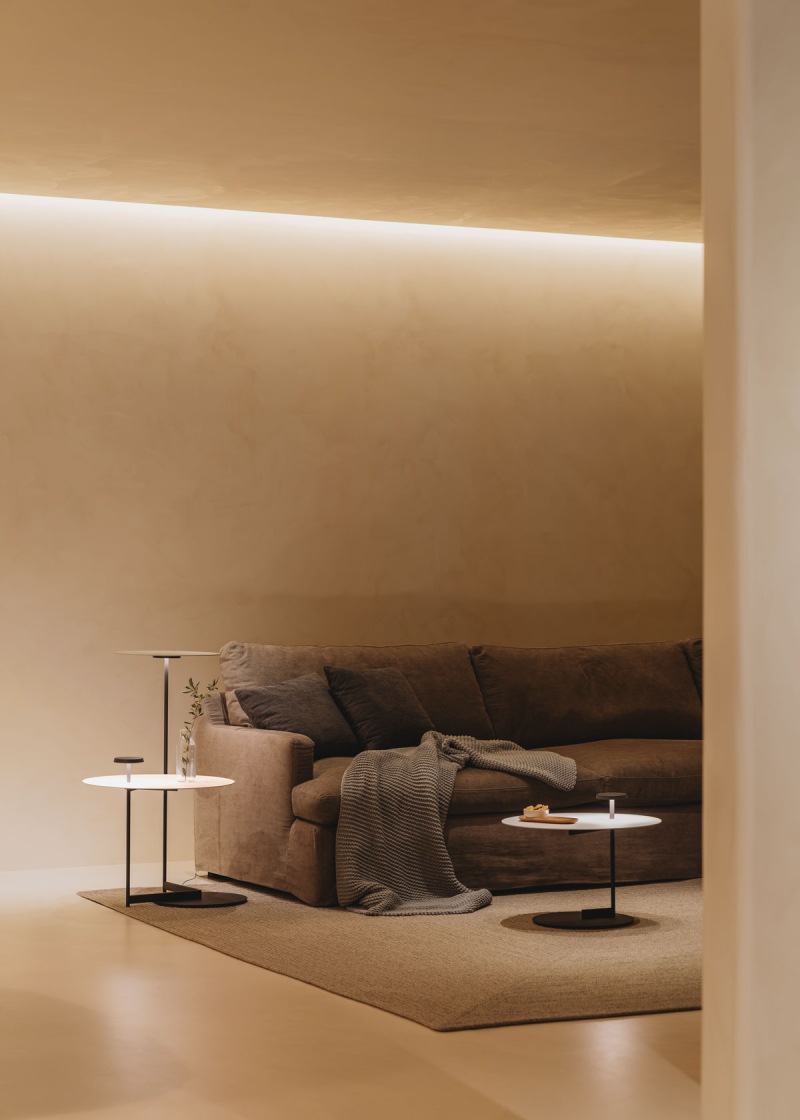
The living room is the heart of every home: a place to welcome and entertain guests; a space where families gather to celebrate holidays and birthdays; a place to relax, play, read or watch TV. As the days get shorter and the nights get colder, we tend to want to evoke the longed-for Scandinavian concept of hygge by decorating our living rooms with piles of blankets, cushions and rugs. While it is important to have soft furnishings to sink into, ambient lighting is the secret to a cosy indoor space. Quality lighting can be intimate or social, relaxing or stimulating, and is essential to create a sense of warmth and wellbeing. An elegant choice for quiet coffee drinking, the North pendant floor lamp by Arik Levy has a dynamic, deconstructed silhouette. Here it appears in a subtle graphite finish and shows how it synthesises the classic floor and pendant lamp by combining floor and ceiling. The elegant conical shade hangs from the end of a slender carbon fibre rod, which is held to the floor by a simple counterweight. The angle of the rod is adjustable, allowing the light to be directed precisely onto a coffee table or a cosy sofa.

Tempo, a design by Lievore Altherr, features slender lines and a long, adjustable arm that extends from the vertical base. It is the perfect companion for a relaxed aperitif and its translucent diffuser made of brown glass adds volume to the otherwise linear design. The delicate oval of opal glass hangs gracefully in the air, filling the room with a soft, diffuse glow and conveying a sense of calm. Soft lighting is the key to a cosy evening at home. Dama combines the charm of the traditional floor or table lamp with the sophistication of modern lighting design to create intimate atmospheres with an upscale aesthetic. It is a Roberto Palomba and Ludovica Serafini creation whose delicate base and frame allow the paper diffuser to seemingly float in free space, with the round LED shining out of it with a subtle, even glow.
Turn your living room into a winter oasis

The philosophy of Karman designer lamps

Be, Amaze, Create. Three words express the leitmotif that inspires Karman in the creation of its designer lamps. Whether for the indoors or outdoors, decorative lighting must be capable of giving every context functionality and magic. It must be able to surprise and excite and give life to a unique environment with a strong personality. Whether it is decorative lamps for prestigious private homes or contract lighting for hotels, restaurants, and more exclusive clubs, Karman is able to propose the solutions that best suit the mood of each location to make it unforgettable. These designer suspension, wall, ceiling, and table lamps have innovative shapes, materials, and technology, and meet every lighting and style need.
Will to dream by keeping our feet on the ground, being aware of the essential role that decorative lighting plays in giving each location a strong aesthetic impact while ensuring the right visual comfort. Roots in the Italian province and keep the gaze to far horizons. Lateral thinking and concreteness. Shared values like common passion for lighting meant as function and magic. That is like a sheet of paper becomes a unique designer lamp where you can write down words of love. Karman an Italian company was founded 2005 in Fossombrone in the heart of Marche region and it keeps experiencing new unconventional materials and distributing its decorative lamps, which bear the indelible mark of made in Italy quality, on a world scale.
A look on unpredictability of things, lightness of insight, dream, ability to create and the emotion of being astonished by arousing a smile and curiosity. Every time a different alchemy leads Karman Lamps to design not simple lamps but new lighting sculptures. Every time a different story becoming central idea of new projects. Lighting is a continuous source of inspiration. It is that imperceptible element able to dress up surroundings and to look at them from a different perspective thanks to designer lighting that leaves an impression.
Experiment, dare, innovate. Karman world moves itself with simplicity towards an original and personal decorative use of lighting in both private surroundings and public spaces. Every designer Karman lamp has something to say, it is a recollection becoming a true embodiment and a piece of real life. All designers’ styles blend and coexist happily between tradition and modernity inspired by research and the ability to create beauty with skillful use of technique.

The philosophy of Karman designer lamps

The Vistosi Peggy pendant lamp in several finishes

White and black. From this chromatic and material polarity Vistosi Peggy was born. This lighting design by Hangar Design Group combines the lightness of white blown glass, entirely handmade, with the liveliest character of the polished, lead-coloured metal. The effective combination communicates rationality and elegance at the same time. It is no coincidence that this system illuminates the café of the Peggy Guggenheim Museum in Venice. Available in the following versions: suspension, applique and a new floor version. White glossy glass. Metal parts finishing in glossy black and painted brass.

The Vistosi Peggy pendant lamp in several finishes

The Licht im Raum Ocular Series 100 Big Lens

Ocular technology can now be experienced in a new dimension. With clearly more light. No matter ?whether you need a lamp in the residential or commercial area – the Ocular Series 100 also creates great atmosphere and abundant light in the object with its large lenses.
The use of the latest LED technology in the Series 100 expands the possibilities even further. On the one hand, from a technical point of view, with 20?W LED/1914 lumens and the large lenses, it achieves an enormous light output; it is also dimmable as standard. On the other hand, the closed profiles round off its design harmoniously. 100 percent good light. All models are available in six different finishes to stage rooms in just the right way: Brushed stainless steel, hand-polished stainless steel, natural brass, matte black, white and newly added black/gold finish.

The Original. Licht im raum Ocular started a trend in lighting design in the mid-1990s that continues today. With a luminaire system that has a sophisticated lens system. Which makes its lighting modules visible. And which achieves outstanding lighting quality with its direct and indirect ?illumination, which is glare-free and dimmable. In the meantime, there are many imitators. But Ocular is the original. And that is precisely why we have reinvented it time and time again. With a creative design team, we have succeeded in making a brilliant light module suitable for a wide variety of applications – always at the cutting edge of lighting technology. LED technology in particular is a perfect fit for Ocular. Here, in the technology, we work closely with the world market leader CITIZEN ELECTRONICS from Japan. The result: brilliant light with perfect dimming and a very long service life. The actual production takes place almost completely in our Solingen manufactory. It is the real strength of Light in Space. With our craftsmanship capabilities, we can configure Ocular into almost any shape and size.

With the Licht im Raum Ocular, our lamp makers can show off their accumulated experience. In fact, they have to, because the lamp is a high-tech product that is completely handcrafted. For example, two different types of light (direct and indirect) have to be combined in one lamp. Or to hide all the wiring behind a slim construction. This is delicate work that can only be done with specially manufactured tools. For the lens, the heart of the lamp, the work is more in the development process. Here, our design team invested a lot of time to find the optimal lens in each case. It’s a bit of a science. Just this much: they are aspherically ground projector lenses made of real glass and manufactured in Germany. Depending on the application, transparent, frosted and structured lenses are used. The result is always a bright spot.

The Licht im Raum Ocular Series 100 Big Lens

How to illuminate a store

LED lighting plays an essential role in stores to increase sales. Light sources not only provide visibility but are also a valuable marketing tool. Through lighting, in fact, products can be highlighted by accentuating their colors in a natural way. This will contribute to a significant increase in the number of visitors and purchases. In addition, well-designed lighting makes it possible to create a pleasant atmosphere, capable of creating the best conditions for customers to make purchases. The secret to perfect lighting lies in finding the right balance between accent and general lighting.

How to illuminate a store

Store windows

A store’s window represents its business card. Not surprisingly, a storefront full of lights and colors will have a higher probability of attracting the gaze and curiosity of passing potential customers. Store owners know this well: a visitor’s first impression of a store window will determine his or her eventual visit. To enhance and make the most of this space, even, flicker-free lighting is recommended. Specifically, adjustable LED spotlights and track spotlights can be used to illuminate mannequins.

Product presentation

Eighty percent of an environment is perceived through the sense of sight. Therefore, it is important to present products for sale in the best light. Accent lighting helps to enhance specific objects or areas within a store. This type of lighting provides bright, crisp colors that can draw the attention of visitors. Spotlights with a high color rendering index (CRI) of 90-99 Ra are recommended for this purpose. This characteristic allows colors to be reproduced genuinely, without altering their naturalness.

General lighting

Lighting is essential to aid customer orientation as customers enter the store. A common mistake in stores is to light the entire display space in the same way. What should be done instead is to create contrasts. The most effective way to achieve this is through dimmable LED spotlights or downlights that can be installed recessed. The right combination of light and shadow, then, will help not only to promote orientation but also to highlight the products you wish to promote.

Warm light or cool light?

The choice of color temperature within the store is important, as it will determine the customer’s purchase of the product. Specifically, depending on the type of products for sale, it is advisable to opt for a different temperature. For example, for jewelry items and for cosmetic, pharmaceutical or optical products, a cool color temperature (4000 to 4500 Kelvin) is recommended. For clothing items, on the other hand, it is better to opt for a warm shade ( 2700- 3000 Kelvin).

The importance of lighting for your architectural design

Lighting has a big impact on the rooms in your house or the work spaces in your office. A beautiful room can look bad because of bad lighting and an ugly space can get a much better look thanks to quality lighting.

In recent years, there has been a broad interest in light, lighting and lighting design among designers throughout the world, but also among architects. One of the main reasons behind this, is the growing awareness of the fact that architecture in 2017 has become more thoughtful and increasingly uses free forms. This also increases the need for quality architectural lighting. Standardized light concepts might still meet the more static architecture of the recent past, but the variation we see in contemporary architecture requires diverse and distinctive possibilities in terms of lighting.

The importance of lighting for your architectural design

That’s why the range of light sources and luminaires we know today is so extensive. So that it is seamless and perfectly implementable in a lot of different architectural designs. An architect has no need for lighting devices, but for light, atmosphere and comfort. The product should be minimally present in the architecture and should be kept in the background, so the light can steal the show. Not the luminaire. Successfully integrating lighting in your design requires knowledge and insights about products, technologies and especially about the effects and impact of light.

Good lighting brings about positive effects that may be of importance to quality of life and which can affect comfort, productivity, and even human health. On average, about 20% of the energy consumption in a building goes to lighting. Do not underestimate its value, so take the time to have an eye for energy efficiency in a lighting plan.
Good light quality is based on the balance between three pillars:

  • Human needs
  • Architectural considerations
  • Energy efficiency

Human needs

It has been proven more than once that the quality of light in a building affects the people in it. Thus, the satisfaction and productivity of an office employee can be positively influenced by a well-designed lighting plan. Owners or managers have the potential to add value and reduce costs by investing in good, qualitative lighting. It is no secret that people are attracted to well-lit public facilities, commercial complexes or parks. Good lighting improves the mood and desirability of such spaces and can greatly contribute to a sense of well-being.

healthcare

Architectural considerations

Evolutions in techniques and technology have made the role of a lighting specialist or lighting designer crucial for the success of an architectural project. The possibilities have become endless. However, seamless integration into modern architecture becomes more complex with the day and requires knowledge. Lighting design has become a creative extension of architecture. The main objective of lighting in an architectural design can be deduced to compliment the present shapes and colors.
Energy efficiency

We are aware that energy costs and efficiency today are more important than ever. In each project, one should aim for a result with a small ecological footprint and strong performance in terms of sustainability and energy consumption. Light control is a way to make your lighting ‘perform’ better on these elements. By using dimmers and (intelligent) controls, for instance, you can enlighten a space to the task that is performed in that location. Integration with other ventilation or airco technologies can also play a role in this.

Festive lights despite the energy crisis ?

Every year, many people start decorating their homes for Christmas as early as November. From the classic fairy lights to the colorful reindeer sleigh, there are no limits to creativity in the house, apartment or garden. But especially in view of rising electricity prices, consumers want to opt for particularly energy-saving and sustainable Christmas lighting this year. Florian Hockel, product expert at TÜV SÜD, gives tips for energy-saving decoration during Advent and explains what else to look out for when buying fairy lights and the like.

Saving tips for Christmas lighting

For many people, lighting is as much a part of the Christmas season as cookies and Christmas markets. Who wants to save electricity and costs, does not have to do without the atmospheric Christmas decoration by any means. “The energy consumption of a chain of lights depends greatly on the model. LED light chains are much more sustainable than the older models with incandescent bulbs. The light-emitting diodes not only last many times longer, they also consume 80 to 90 percent less electricity,” says Florian Hockel. LEDs are also ahead in terms of safety: in most cases, the chains are powered by means of electronic LED control gear, which provides a much lower voltage (12V / 24V or similar) for the fairy lights from the 230V mains voltage. Due to the overall very low power consumption, the LEDs do not get as hot as conventional incandescent lights during long running times and have a much lower risk of overheating and fire. It also minimizes the risk of electric shock.

“Consumers should just be careful not to buy battery-powered LED lighting, but rather a model with a connection for the mains power supply if possible, because battery power is significantly more expensive in total than electricity from the socket. A battery-operated LED light chain can under certain conditions even come to higher operating costs than lighting with incandescent or halogen lamps,” the expert knows. Apart from the financial expenditure batteries and Akkus carry additional dangers for environment and health. In terms of sustainability, rechargeable batteries are better than disposable batteries in Christmas decorations. They can be recharged 500 to 1,000 times, replacing a large amount of the disposable models. But does rechargeable automatically mean cheaper? “Not at first – but if you consider that rechargeable batteries can last between five and ten years, you can save a not inconsiderable amount of money in most cases compared to normal batteries,” says Florian Hockel.


BROKIS introduced the new lamp collections OVERLAY and PRISMA

The new products for this autumn present a sublime synergy of advanced technologies, precision Bohemian glassmaking, and sustainable materials that embody the brand’s commitment to protecting the planet. Both collections were created by BROKIS art director Lucie Koldova, proudly taking their place in a brilliant portfolio of lights by this renowned designer.

Modern yet timeless. Extravagant in its style and use of clean geometric forms. Inspired by architecture. The Overlay collection arose from a synthesis of various materials on mood boards during a creative process that involved seeking ideas and associations between art and design, overlaying different textures, and playing with volumes.

The blown transparent glass tubes instil the Overlay collection with a distinctive character, as does the unique concrete fixture embedded with shards of upcycled glass from Janštejn Glassworks. The piece is cast in different rectangular volumes specifically for each type of light capable of accommodating both simple and multiple compositions. Cradled within the concrete fixture is a delicate sleeve of either frosted or clear glass, its centreline struck by a light tube that seemingly levitates within. The typology of the Overlay collection comprises horizontal pendant variants, table lights, and wall lights that open the door to a new realm of possibilities in lighting art.

The dominant feature of the Prisma collection is an extravagant metal fixture with a distinctive finish. Classic handblown glass spheres are anchored to either one or both ends of a robust decagonal metal prism that lends the collection its name. The shape in combination with the striking surface reflect light at different and unexpected angles, like a prism. With a choice of three different elegant finishes – brushed steel, galvanized yellow zinc gloss, or galvanized yellow zinc matte – the light is a bold artistic object in the interior offering unique vertical, horizontal, and diagonal compositions with subtle colourful reflections.

The collection consists of a horizontal pendent light with two dual glass spheres and a vertical pendent light with a single glass sphere, both of which hang from wire ropes. Another typological variant is an impressive floor light, a majestic light sculpture in the form of a robust upright decagon topped with a luminous glass sphere. The structured finish on the metal fixture is one of the defining traits of the collection, and together with transparent glass or grey smoke glass constitutes a jewel with which to adorn private interiors as well as hotels and restaurants.

Modern LED Lamps and Light bulbs

An LED lamp or LED light bulb is an electric light that produces light using light-emitting diodes (LEDs). LED lamps are significantly more energy-efficient than equivalent incandescent lamps and can be significantly more efficient than most fluorescent lamps. The most efficient commercially available LED lamps have efficiencies of 200 lumen per watt (Lm/W). Commercial LED lamps have a lifespan many times longer than incandescent lamps.

LED lamps require an electronic LED driver circuit to operate from mains power lines, and losses from this circuit means that the efficiency of the lamp is lower than the efficiency of the LED chips it uses. The driver circuit may require special features to be compatible with lamp dimmers intended for use on incandescent lamps. Generally the current waveform contains some amount of distortion, depending on the luminaires’ technology.

The LED lamp market is projected to grow from US$75.8 billion in 2020 and increasing to US$160 billion in 2026.

LEDs come to full brightness immediately with no warm-up delay. Frequent switching on and off does not reduce life expectancy as with fluorescent lighting. Light output decreases gradually over the lifetime of the LED (see Efficiency droop section).

Some LED lamps are drop-in replacements for incandescent or fluorescent lamps. LED lamps may use multiple LED packages for improved light dispersal, heat dissipation, and overall cost. The text on retail LED lamp packaging may show the light output in lumen, the power consumption in watts, the color temperature in Kelvin or a color description such as “warm white”, “cool white” or “daylight”, the operating temperature range, and sometimes the equivalent wattage of an incandescent lamp delivering the same output in lumen.

A new Showroom for Lamps in Milano, Italy

Ceramiche Ragno, a historic brand in the Italian ceramics industry, opens its first flagship showroom in Milan, designed by Benedetta Tagliabue. The 400-m² space, with its large arched windows overlooking Via Marco Polo in the iconic Porta Nuova district, has been interpreted by Benedetta Tagliabue as a kaleidoscope of colours, textures and patterns that tell a surprising story of the brand’s history and technical and craftsmanship skills and all the expressive potential of ceramics. In this space we find Bovers lamps, also designed by Benedetta Tagliabue: Dome and Domita, this one designed together with Joana Bover. With the Bover DOME we decided to take the light out of the object so it becomes a light sculpture designed to receive and emit a delicate light, a play of shadows and nuances that enrich the space for which they were created. From the beginning of the creation of the Bover Dome, we knew that sooner or later we should expand the collection with smaller versions that allow us to create lighter spaces. More than 170 fragments are needed to compose this great meccano of small and large pieces of wood, wisely intertwined and sewn one by one by the expert hands of those who know well the manual trade that requires the making and care of all our products. Under these premises were born the Domitas, lamps made with thin wooden slats that converge between them, forming a small dome that keeps inside the LED source.

bover-dome