The Serien Lighting App Wall LED Lamp

Clever light, creative diversity! A formally simple LED light cube shows what it’s made of. With its double-layered front surface, it opens up maximum design freedom. The range of available standard fronts alone extends from different textured surfaces and soft matt colors to mirrored surfaces and those with optical effects. If you want to make a statement or convey a message, APP can be personalized with individual prints. Notes, room numbers, company colors … The choice is yours.

The Serien Lighting APP wall light is not just an energy-efficient light source. Its customizable front surface, which provides visual depth and plasticity, also opens up unimagined design freedom. APP thus becomes a potential information carrier, guidance system and design element. The latest long-life technology is contained in two high-intensity replaceable LED boards. These emit intense light symmetrically upwards and downwards, which is reflected into the room via the wall, ceiling and floor. The light falling through the side of the cuboid, on the other hand, is gently diffused and completely glare-free! The choice of front surface has no influence on the room light itself, as its carrier plate is opaque. An efficient heat sink on the back of the cuboid ensures heat dissipation and is also a design element.

Serien Lighting App


Whether arranged in rows, graphically or in a deliberately free arrangement – APP is predestined for multifunctional use. In private rooms, hotels, hospitals, office buildings, corridors, entrance areas and staircases, which APP transforms into conceptual lighting installations.

The Serien Lighting App Wall LED is a wall light whose design you can determine yourself. This is because the front surface is available in many different versions. Whether textured like “Broken Ice” or “Comb”, fluorescent or with a reflective surface (Mirror): You decide in which design the App Wall presents itself. For this, it received the Design Plus Award at Light+Building 2016. The choice of surface has no influence on the lighting effect. The wall light from German manufacturer Serien Lighting is made of high-quality aluminum and polycarbonate.

Sound-absorbing lamps from Bover

Today, effective sound management is more important than ever. Poor acoustics can lead to distractions, reduced productivity and even higher stress levels. Incorporating sound-absorbing elements into spaces can dramatically improve comfort and functionality. Products that manage noise levels not only improve the overall atmosphere, but also contribute to better communication, collaboration and well-being.

Two of our featured products – the Bover Mei and the Bover Noren – offer exceptional acoustic sound-absorbing qualities while enhancing the aesthetic appeal of any space.

The Bover Noren are lightweight, decorative structures with upholstered acoustic panels. These innovative pieces not only help define space, but also address the challenges of managing both sound and light. Named after the traditional Japanese fabric curtains used to define space, Noren is a modern solution that replaces walls, doors or windows.

Its presence is transformative; even when unlit, Noren acts as a sculptural object, adding personality to the environment. This makes them ideal for communal and work environments where atmosphere and aesthetics are key. By reducing ambient noise, Noren improves concentration and facilitates clearer communication, making it a perfect addition to offices, meeting rooms and collaborative spaces. They are upholstered in Crevin® fabric and can be customised.

The lamps in the Bover Mei collection have been designed with versatility in mind. Their sound-absorbing features enhance comfort while maintaining a modern and sleek appearance. The combination of functionality and style makes the Bover Mei perfect for a variety of applications, from open-plan offices to cosy living rooms. By reducing noise, Mei creates a serene atmosphere that promotes productivity and well-being, allowing people to concentrate and interact more effectively.

Bover NorenBover Mei


Incorporating sound absorbing elements such as the Bover Noren and the Bover Mei can significantly improve the acoustic environment of any space. Good acoustics contribute to higher employee satisfaction, reduced stress levels and better communication, ultimately leading to greater productivity. Combining decorative features with practical benefits, these products ensure that both sound and light are managed effectively, creating a harmonious atmosphere that promotes wellbeing. Whether in a workspace or a communal area, these solutions are designed to have a lasting impact, demonstrating that design can transform not only how a space looks, but also how it feels.

Joan Gaspar talks about the Ginger collection from Marset

Joan Gaspar learned the trade of industrial design by working with Lluís Porqueras in the late 1980’s in a small lamp workshop in Barcelona’s Poble Nou neighborhood. Since then he has designed countless products, all characterized by simplicity as their unquestioned hallmark, with a special focus on the lighting sector. However, he is also on the verge of celebrating two decades as the Product Manager at Marset. Gaspar is interested in talking about what we do not see in lamps. What we see, he says, is obvious. You can tell that he enjoys finding solutions to any issue put to him, paper and pencil in hand, or turning the object around and around. It is clear that he likes all his i’s dotted and t’s crossed.

Joan Gaspar talks about the Ginger collection from Marset Lighting

– I’ve counted 25 of your products in the current Marset catalogue. I imagine you’ve designed quite a few more. What does the latest, Ginger, bring to the world of lamps?
– I wanted to work with a new material and a new technology applied to the sector for the first time. High-pressure shaping of several layers of wood and paper enables you to get a very thin lamp plate, just 4 mm thick. It would be twice as thick if you used plywood. Plus, since it is made of two materials you can put the white side on the inside to help reflect the light. The bulb holder is an aluminum “pin” which comes with LED’s and special optics to open up the light beam, although it in no way resembles a bulb holder. To dissipate the temperature transmitted by the LED, I chose not to carve out grooves but instead to make the aluminum thicker and keep the piece intact. As a whole, it is an exceptionally flat, smooth lamp.

– Both Ginger and the Polo spotlight use LED’s. What is this technology missing to become the perfect source of light?
– At first it was not very powerful and highly invasive. In just a short time not only have LEDs become high-performance and low-consumption, they are also increasingly warmer and smaller and have better light quality. The major revolution is that you can build your own light source. You can make your own customized bulb holder. You don’t have to go looking for anything.

– Many designers feel nostalgic for incandescent bulbs. Have you gotten over that?
– It seemed like a minor disaster when those bulbs were taken away. At first I amassed a great deal of stock. When I found white ones, I would buy them and hoard them. But I’m over the nostalgia now. Plus, today there are LED’s in the shape of white bulbs which provide amazing light. And there are aberrations, too. But generally speaking, things are going well. And LED’s allow you to design lights with standard sources, too. We work on a light as an object; it has to illuminate well, but it also has to decorate.

– With LED’s, lights are increasingly slimmer and smaller. It seems like they’re going to vanish entirely.
– Actually you can do whatever you want with them. The time will come when you’ll no longer be able to tell whether or not a light has an LED. The fact is that they give you a great deal of freedom. You can also use them in large lamps, such as the Soho, which measures 112 cm in diameter. The other day I saw one hanging in a market in Barcelona and I was thrilled. The important question is whether they provide good light and are attractive.

– What strikes me is the simplicity of your designs.
– I’m not into trendy things. It is difficult to remain on the sidelines: magazines, the media, the street. But to me value lies in simplicity, in something that is well made, that lasts for years. Being simple does not mean that the process of getting there is simple. It can actually be very complex. My master was the designer Lluís Porqueras. I began to work in his company, Vapor, in the late 1980’s. And he made everything easy. Objects have to be in a place without making noise, without clamoring for attention. If I find something spectacular, I immediately start suffering.

– Why did you relaunch the Funiculí lamp, which was designed by Porqueras in 1979?
– It is a very heartfelt tribute to Lluís Porqueras. I learned the trade from him. And of all the lamps he made, this one was the best. Tons of them were sold in just a brief period of time. Still, because of the lack of resources at that time, he was unable to manufacture a mold for the lampshade, for example. I just made use of an industrial piece that already existed. Now we produce it in its entirety with all its features, which are considerable.

– Every period has had its materials and technologies. How do you think 2014 will be remembered in the future?
– Things will appear very well made from the technological standpoint. But the perception will be that there is a mixture of periods, although everything is warmer, softer, quieter. People want to relax; they want things to be normal. When I got my start in Barcelona in the late 1980’s and early 1990’s, everything that was being done was outrageous. Today I find those chrome and black designer bars horrible. Yet they were also very important because they signaled that businesses were getting off the ground. Back then we designers were quacks – everyone wanted to be modern, or faux modern.

– Today the typologies are also being constantly revised.
– It is difficult to invent new lamp typologies. Castiglioni did it with Arco and Parentesi. So did George Carwardine’s articulated tabletop flexible lamp. Ingo Maurer’s Yayaho was revolutionary with the advent of halogen. Today some of the innovation is coming from applying new materials and technologies.

– Even though today you also design other products, you always veer back towards lamps. What are the challenges of designing lamps?
– It is easier to design a lamp than a chair. You have the light dimension, which makes the object change when you turn it on. This is an advantage because it gives the product an added dimension.

– As the Product Manager at Marset, what is your mission?
– I am like the curator; I determine the perception of each lamp, the quality of light. When I joined Marset in 1996, they had already taken several steps towards carrying more contemporary products, and we just kept going further in that direction. I also think it is important to seek other technologies as a way of making a different kind of product. In 2000, for example, we introduced plastic in the company with a fairly risky proposition. And it was very successful. At that time, the Atlas lamp was a very unusual spotlight set inside a transparent case which held it in place. Everything was held together with just two pieces, without any screws or even a ball and socket to move the head. Plus, polycarbonate brought additional shine that gave it a different quality. When we launched it, we made two versions: one opaque and one transparent, which was the one we were nervous about. We thought it went too far, and in fact it’s the one that was incredibly successful. I have thoroughly internalized the Marset catalogue, and every now and then I make my own proposals.

– The job also involves discovering new talents.
– Marset receives many proposals, and only some of them are actually brought to fruition. I saw the Scantling lamp by Mathias Hahn on a website where prototypes are published. I called him, we added it to the catalogue and today it is a great product. This possibility is one in a thousand. Publishing without being manufactured: that is what many young designers do today. I would be unable to do it. In the past, you published what had been manufactured. Today you publish the proposal. I’m from the old school.

Joan Gaspar Joan Gaspar

Nautilus, a family of wall/ceiling lamps by the manufacturer Lodes

Powerful design and cutting-edge technology come together in Nautilus, a family of wall and ceiling lamps. The lamp is characterized by a convex lens that projects the LED light where it is needed or preferred, for a truly efficient and personalized result. With Nautilus, we explore relationships – the bond between our products and users, and the interaction between lamps and the environments they light up. Nautilus can be used as a single element to project direct light symmetrically in opposite directions. Alternatively, the mobility of the diffusers, which can be separated with an opening of up to 90° and rotated through 320°, allows the two light beams to be managed individually at will. Versatile and dynamic, wall, ceiling or pendant in a wide range of versions and finishes, Nautilus luminaires can satisfy all lighting needs, whether functional or purely decorative, in both residential and commercial contexts. Formerly known as Studio Italia Design, Lodes completed a rebranding process in June 2020 – on the occasion of its 70th anniversary – which culminated in the unveiling of the new logo and brand identity. Since then, as part of a strategic vision led by General Manager Massimiliano Tosetto, Lodes has been ushering in a new era of contemporary design that celebrates the company’s manufacturing expertise and high-quality Made in Italy essence. Lodes, based in Venice, has been designing and producing lighting solutions for interiors and exteriors since 1950, balancing technical know-how with the best of Made in Italy design. Born from founder Angelo Tosetto’s passion for glass and driven by continuous technological research, the company has become one of Europe’s leading designers and manufacturers of decorative lighting, currently present in 90 markets worldwide.

The new Licht im Raum Ocular Series 100 Big Lens

Now you can experience a new dimension in eyewear technology. With significantly more light. Whether you need a luminaire for residential or commercial applications, the Ocular Series 100 with its large lenses creates a great atmosphere and plenty of light inside the object.
The use of the latest LED technology in the Series 100 expands the possibilities even further. On the one hand, from a technical point of view, the 20W LED/1914 lumens and large lenses provide an enormous light output and are dimmable as standard. On the other hand, the closed profiles round off the design harmoniously. 100 per cent good light. All models are available in six different finishes to set the stage for any room: Brushed stainless steel, polished stainless steel, natural brass, matt black, white and the new black/gold finish.

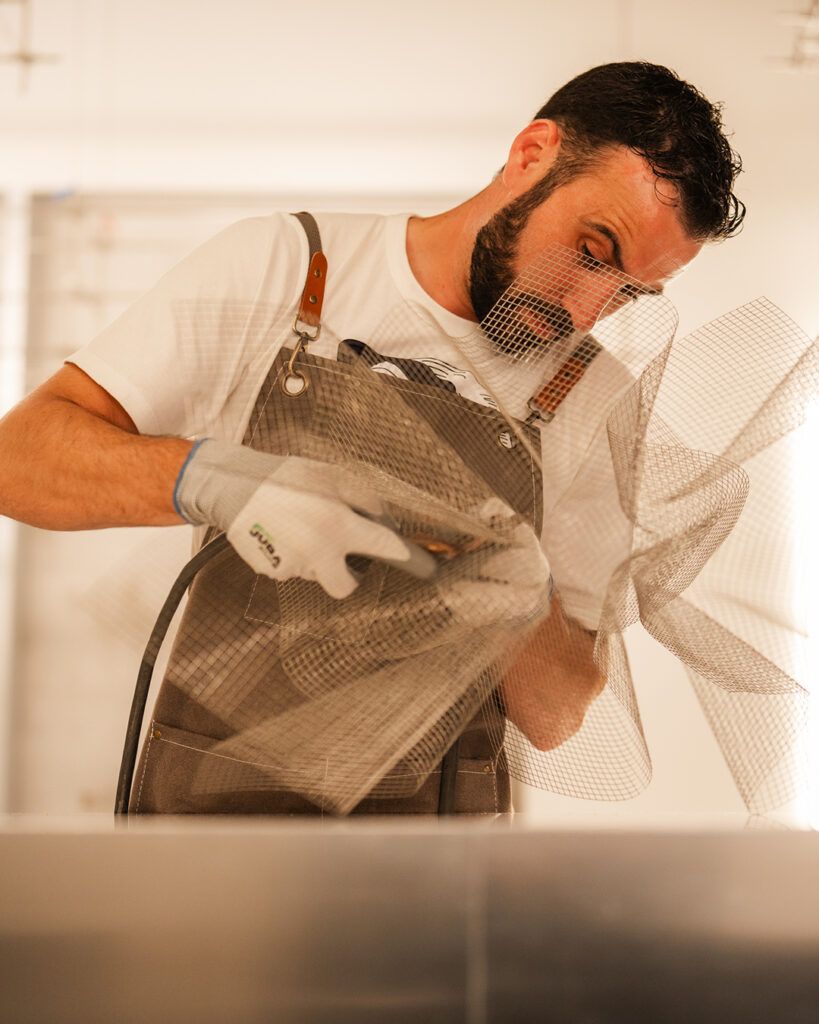
The Original. Ocular started a trend in lighting design in the mid-1990s that continues today. With a luminaire system that has a sophisticated lens system. Which makes its lighting modules visible. And which achieves outstanding lighting quality with its direct and indirect ?illumination, which is glare-free and dimmable. In the meantime, there are many imitators. But Ocular is the original. And that is precisely why we have reinvented it time and time again. With a creative design team, we have succeeded in making a brilliant light module suitable for a wide variety of applications – always at the cutting edge of lighting technology. LED technology in particular is a perfect fit for Ocular. Here, in the technology, we work closely with the world market leader CITIZEN ELECTRONICS from Japan. The result: brilliant light with perfect dimming and a very long service life. The actual production takes place almost completely in our Solingen manufactory. It is the real strength of Light in Space. With our craftsmanship capabilities, we can configure Ocular into almost any shape and size.

With the Licht im Raum Ocular, our lamp makers can show off their accumulated experience. In fact, they have to, because the lamp is a high-tech product that is completely handcrafted. For example, two different types of light (direct and indirect) have to be combined in one lamp. Or to hide all the wiring behind a slim construction. This is delicate work that can only be done with specially manufactured tools. For the lens, the heart of the lamp, the work is more in the development process. Here, our design team invested a lot of time to find the optimal lens in each case. It’s a bit of a science. Just this much: they are aspherically ground projector lenses made of real glass and manufactured in Germany. Depending on the application, transparent, frosted and structured lenses are used. The result is always a bright spot.

The Licht im Raum Ocular Series 100 Big Lens

The Foscarini Nile and Chiaroscura receive the ADI Design Award

The permanent design watchdog once again selected Foscarini for its design excellence and pioneering spirit. These characteristic features of the brand are embodied in 2023 by the Nile and Chiaroscura luminaires, which were selected for the Lighting Design category. The Nile table lamp designed by Rodolfo Dordoni is a furnishing element with an impressive effect. It is already beautiful when switched off, but when switched on it reveals its true fascination. The light shines through the precious, hand-blown glass and streams through both sides of the diffuser onto the surface below. A luminaire sculpture in which opposing elements interact, united in a composition of volumes that seem to defy all the laws of gravity.
“I wanted a sculptural presence, a real diffuser of light, with a form that is not necessarily functional. I drew two overlapping volumes: the small marble base and the large glass diffuser. When I looked at them, the famous bust of the Egyptian Queen Nefertiti came to mind and that’s how I came up with the name: Nile.” – Rodolfo Dordoni

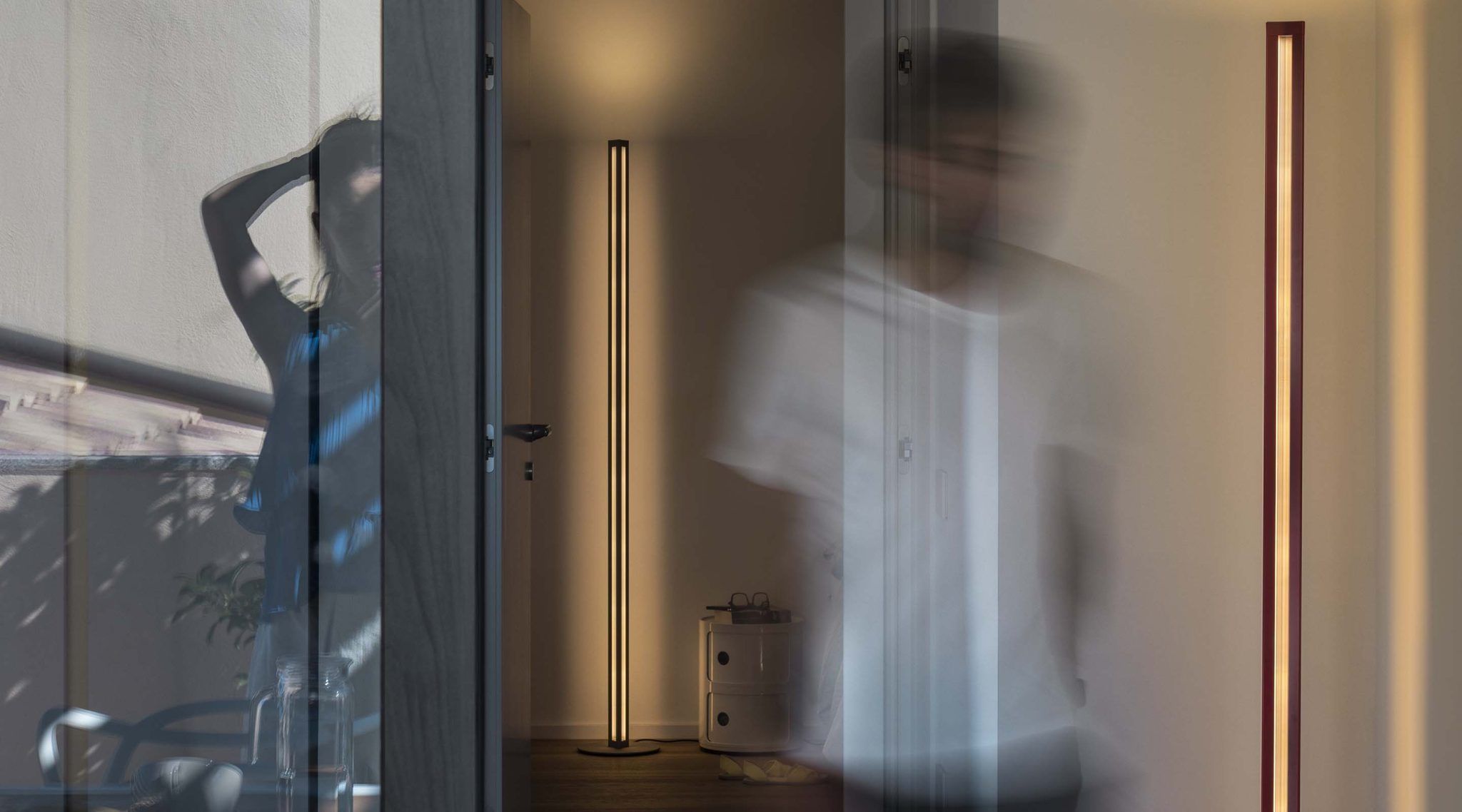
The Foscarini Chiaroscura is an elegant ceiling washlight that not only emits strong indirect light upwards, but also indirect light onto the wall or diffusely into the room. The slim design and its warm, inviting light make the floor lamp a versatile lighting object that enriches living and working spaces with attractive lighting effects and, thanks to its discreet presence, becomes a furnishing object with a strong character. Chiaroscura consists of three half arches that form a unique triangular cross-section. This design choice creates a balanced presence that can change depending on the viewing angle. The frame features a combination of matt and shiny surfaces to enhance the visual impact of the luminaire. It is made of pressed aluminum and PMMA, which create transparency and a pleasant diffusion of light.

The designer floor lamp was the result of a design challenge. The two designers Alberto Meda and Francesco Meda from Foscarini explored the possibilities of optimizing the functionality of a classic floor lamp that only emits indirect light upwards. The aim was to design a light and elegant housing that is itself fully illuminated. This was made possible by specially developed LED boards placed along the rod. Chiaroscura, available in the colors dark red and titanium, offers a variety of design options for room lighting and allows users to flexibly adapt to individual needs and requirements in terms of light and atmosphere.

The Foscarini Nile and Chiaroscura receive the ADI Design Award


BROKIS introduced the lamp collections OVERLAY and PRISMA

The new products for this autumn present a sublime synergy of advanced technologies, precision Bohemian glassmaking, and sustainable materials that embody the brand’s commitment to protecting the planet. Both collections were created by BROKIS art director Lucie Koldova, proudly taking their place in a brilliant portfolio of lights by this renowned designer.

Modern yet timeless. Extravagant in its style and use of clean geometric forms. Inspired by architecture. The Overlay collection arose from a synthesis of various materials on mood boards during a creative process that involved seeking ideas and associations between art and design, overlaying different textures, and playing with volumes.

The blown transparent glass tubes instil the Overlay collection with a distinctive character, as does the unique concrete fixture embedded with shards of upcycled glass from Janštejn Glassworks. The piece is cast in different rectangular volumes specifically for each type of light capable of accommodating both simple and multiple compositions. Cradled within the concrete fixture is a delicate sleeve of either frosted or clear glass, its centreline struck by a light tube that seemingly levitates within. The typology of the Overlay collection comprises horizontal pendant variants, table lights, and wall lights that open the door to a new realm of possibilities in lighting art.

The dominant feature of the Prisma collection is an extravagant metal fixture with a distinctive finish. Classic hand-blown glass spheres are anchored to one or both ends of a sturdy decagonal metal prism that gives the collection its name. The shape combined with the striking finish reflects light at different and unexpected angles, like a prism. With a choice of three elegant finishes – brushed steel, galvanized yellow zinc gloss or galvanized yellow zinc matte – the fixture is a bold art object in the home, offering unique vertical, horizontal and diagonal compositions with subtle colored reflections.

The collection consists of a horizontal pendent light with two dual glass spheres and a vertical pendent light with a single glass sphere, both of which hang from wire ropes. Another typological variant is an impressive floor light, a majestic light sculpture in the form of a robust upright decagon topped with a luminous glass sphere. The structured finish on the metal fixture is one of the defining traits of the collection, and together with transparent glass or grey smoke glass constitutes a jewel with which to adorn private interiors as well as hotels and restaurants.

The Foscarini Fleur was honored with an award

The Foscarini Fleur has been recognized in the “Most Illuminating Lighting” category at the Wallpaper* Smart Space Awards. These awards highlight design projects that combine creativity, innovation, sustainability, simplicity and style. The Fleur portable table lamp, designed by Rodolfo Dordoni, has been awarded in the “Most Illuminating Lighting” category at the Wallpaper* Smart Space Awards 2024. This award, now in its fourth year, celebrates excellence in interior design and places particular emphasis on creativity, innovation, sustainability, simplicity and style. The judges recognized Fleur’s ability to combine two different functions – providing natural light and the unexpected ability to hold fresh flowers – “with elegance and style”, meeting the ever-increasing demands for flexibility, aesthetics and functionality. The design of Foscarini Fleur is a refined example of Dordoni’s mastery in creating objects that not only enrich with their aesthetic presence, but also offer practicality and versatility. A stylish yet accessible work in which the transparency and lightness of the clear glass, suitable for water and flowers, are combined with the noble tones of the lamp body, designed to diffuse light over a wide surface: clean lines and high quality materials come together in a portable table lamp that combines poetry, functionality and energy efficiency. This fusion impressed the judges and shows how design can evolve to meet contemporary needs without losing sight of elegance.

The Foscarini Fleur was honored with an award

The essence of Arturo Alvarez’s artistic work

A beam of light crosses the room, trapping thousands of anarchic particles of dust in a static pose, trapped in the powerful performance of a lamp. A creation in which one can perceive a trace, a heritage, the heraldic line of a gesture that mutates from a pencil in frenetic movement to the expert hand that masters a material in its struggle for artistic creation.

At Arturo Alvarez, the gesture is the essence that defines each of our creations. An action, a declaration of intent that marks the first stroke of the designer and the last caress of the craftsman on the material. The gesture is the leitmotif that shapes our lamps; a process in which intuition and technique come together to create pieces that go beyond the decorative, transforming them into objects that radiate soul and character.

After the installation of his sculpture ‘The Spanish people have a road that leads to a star’ for the 1937 Paris International Exposition, Alberto Sánchez decided to stay in Paris until the entire installation was completed, taking special care of the exhibition of the work. His concern for the improvement of the work was evident in the way he understood and produced it, but above all in his attitude to life. An extended vision in which other gestures are sought, other winks that connect Alberto, who, like another worker, built the equipment of the pavilion in Paris, showing that the gesture is embedded in the work as well as in the artist.

The gesture in Arturo Alvarez (a-emotional light) transcends the action and becomes an artistic manifesto in which every movement has a purpose. The gesture of the designer, such as Isaac Piñeiro, Héctor Serrano or the Cenlitros studio, is the first act of creation. It is the moment when an abstract idea becomes a tangible design. First traces that become expressions of creativity and emotion, lines that contain the energy and purpose of their creator. In this sense, the gesture is a language in itself, a form of non-verbal communication that conveys the essence of the design. In every curve, in every line, there is an intention, a choice that reflects the style and personality of the designer. Just as in gestural painting, where the stroke of the brush is not just a means to create an image, but a trace of the artist’s movement and emotion, in a-emotional light each design is a capture of the creative moment, a reflection of the designer’s passion and vision.

The value of the gesture in Arturo Alvarez (a-emotional light) lies in its authenticity, which makes our lamps unique and special. The gesture of the designer and the craftsman becomes a signature, guaranteeing that each piece has its own history and character. This is why lamps by Arturo Alvarez go beyond mere functionality, the result of a creative process that respects tradition and celebrates innovation. From Galicia, where our ideas are born, a-emotional light lamps reflect the magic of the gestures that created them, combining idea and substance.

The essence of Arturo Alvarez's artistic work

The Serien Lighting REFLEX² AND DRAFT luminaire collections

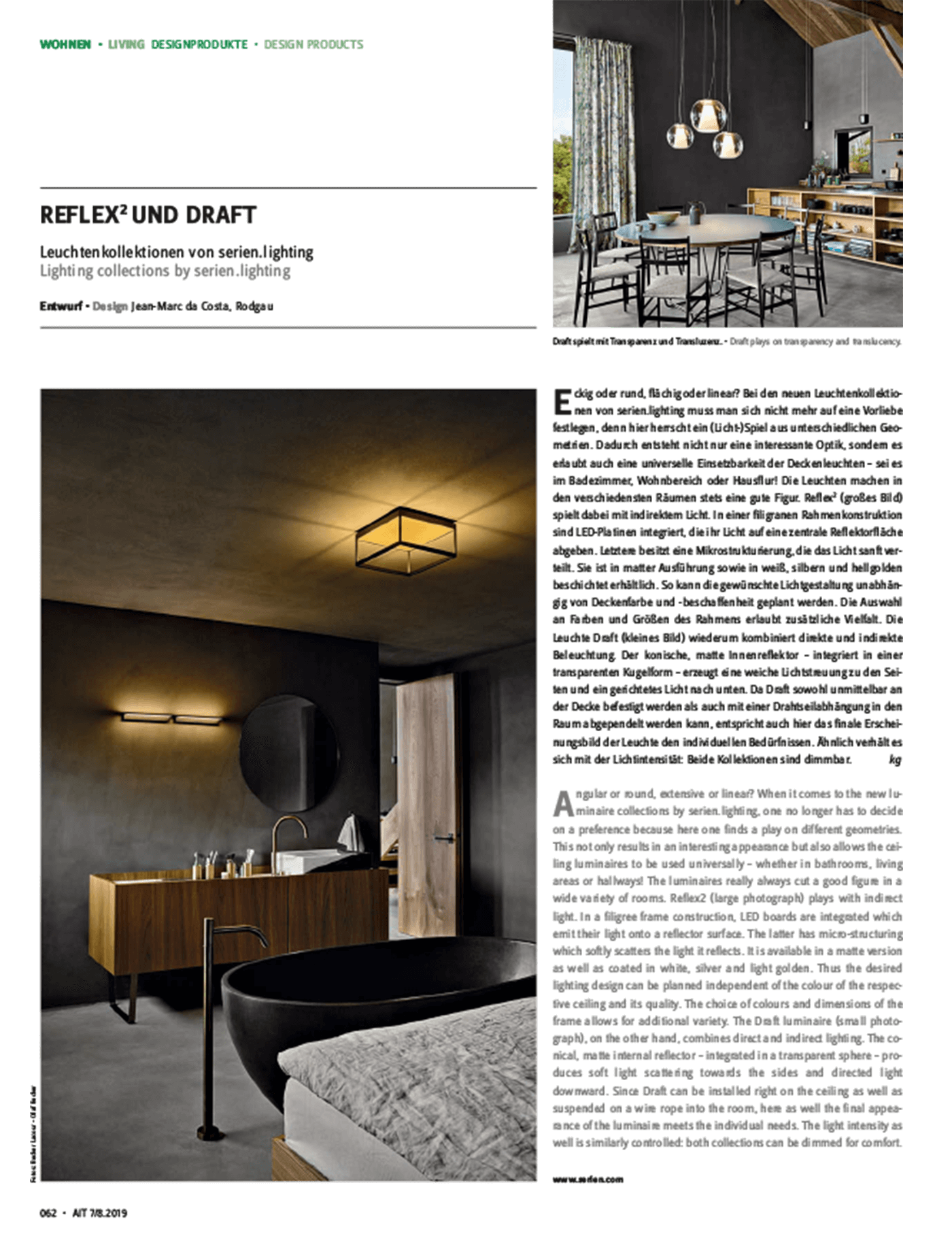
Angular, round, flat or linear – what do you prefer? The new luminaire collections from serien.lighting are so diverse that you no longer have to commit to a preference. Here there is a (light) interplay of different geometries. As a result, not only does everything look great, but you can also use the ceiling lights in completely different rooms – in the bathroom, living area or hallway. The lights simply fit into any room. The “Reflex2” luminaire from Serien Lighting plays with indirect light (large image). The LED boards are integrated into a filigree frame construction and emit their light onto a central reflector surface. The latter has a microstructure that ensures that the light is distributed evenly. You can buy them in a matt finish as well as coated in white, silver and light gold. This allows you to plan the desired lighting design regardless of the color and texture of the ceiling. The choice of colors and sizes of the frame provides additional variety. The Serien Lighting “Draft” luminaire (small picture) combines direct and indirect lighting. The conical, matt internal reflector – which is integrated into a transparent spherical shape – provides soft light diffusion to the sides and directed light downwards. Draft can either be fixed directly to the ceiling or suspended in the room using a wire suspension. This allows you to hang the luminaire according to your own requirements and the result always looks good. You can also easily adjust the light intensity by dimming the luminaire.

Serien Lighting